There is a quiet risk that sits beneath almost every modern business: dependence on software that it neither owns nor controls.
Over the last decade, businesses have increasingly built themselves around subscriptions to third-party platforms. Accounting software, CRMs, project management systems, inventory systems, survey systems, compliance systems, communication platforms, reporting dashboards — the average business now operates across dozens of separate services, each with its own pricing model, roadmap, limitations, and terms of service.
At first, this model appears efficient. Off-the-shelf software is accessible, relatively cheap to adopt, and often quick to implement. For many businesses, especially in their early stages, it makes perfect sense.
The problem emerges later, when the software becomes critical infrastructure.
The Moment You Lose Control
Because the moment your business truly depends on a platform, you are no longer entirely in control of your own operations.
A third-party provider can change its pricing overnight. It can remove features your workflows depend upon. It can lock down API access. It can alter data export policies. It can discontinue integrations. It can be acquired by another company with different priorities. In some cases, it can simply disappear.
Businesses often do not realise how exposed they are until they are forced to migrate years of operational data under pressure, retrain staff on entirely new systems, or rebuild workflows around changes they never asked for.
The irony is that many businesses are paying substantial recurring costs for software that only partially reflects how they actually work.
Instead of software adapting to the business, the business adapts to the software.
The Normalisation of Compromise
Teams create awkward workarounds. They maintain spreadsheets outside the system because the platform cannot handle edge cases. They duplicate data across providers because one application does not communicate properly with another. They restructure internal processes around software limitations that were designed for a generic market rather than their specific operations.
Over time, these compromises become normalised. Nobody questions why the CRM does not talk to the project management tool. Nobody questions why the reporting dashboard cannot pull data from the compliance system. The fragmented architecture becomes accepted as simply how things work.
But it is not how things need to work.
The Changing Economics of Software
Software does not need to work this way anymore.
The economics of software development are changing dramatically, particularly in the era of AI-assisted development. Software has never been faster to prototype, cheaper to build, or easier to iterate upon than it is today.
That does not mean software engineering has become trivial. Highly complex systems still require significant expertise, architectural planning, testing, security considerations, and operational stability. There are real trade-offs. Mission-critical systems still need experienced developers and thoughtful long-term maintenance.
But the reality is that most businesses do not need the complexity of a global SaaS platform.
Most businesses fundamentally need systems that store, organise, retrieve, and manage information.
The CRUD Backbone
At their core, the overwhelming majority of internal business applications revolve around a relatively straightforward concept: CRUD.
Create. Read. Update. Delete.
A customer record is created. An invoice is updated. A compliance document is retrieved. A survey entry is deleted. A project is queried. A report is generated from structured records stored in a database.
That is the operational backbone of most software.
There may be sophisticated functionality layered around it — analytics, automation, integrations, AI summarisation, reporting engines, notifications, permissions systems — but underneath, the central purpose is usually still the management of structured business data.
AI is exceptionally good at accelerating the development of these kinds of systems.
Tasks that once required weeks of repetitive boilerplate development can now often be generated in hours. Database models, administrative interfaces, API endpoints, authentication systems, dashboards, forms, filtering systems, reporting functionality, and document generation pipelines can all be scaffolded rapidly and refined iteratively.
This changes the conversation entirely.
From Luxury to Viable Strategy
Historically, custom software was viewed as something only large enterprises could afford. Bespoke systems carried enormous upfront costs because every piece of infrastructure needed to be built manually from the ground up.
Today, much of that foundational work can be accelerated dramatically.
The result is that more businesses can now realistically consider software ownership as a viable operational strategy.
And ownership matters.
Owning software means owning the workflows that define your business. It means your systems can conform to your operational reality instead of forcing your staff into generic patterns designed for thousands of unrelated organisations.
It means features are implemented because your business needs them — not because they fit within a SaaS provider’s product roadmap.
It means your data structures are built around the information that matters to you.
It means integrations are created specifically for your processes.
It means your software evolves alongside your business instead of becoming an obstacle to it.
Most importantly, it means strategic control.
When a business owns its software, it is no longer entirely exposed to the commercial or technical decisions of unrelated third parties. The software becomes an asset of the business itself rather than a rented dependency.
Infrastructure, Not Identity
This does not necessarily mean abandoning every external service. There will always be situations where specialised third-party providers are the right solution. Commodity services such as payment processing, email delivery, cloud hosting, mapping systems, or accounting integrations often make practical sense to leverage externally.
But there is a growing distinction between using external infrastructure and outsourcing your operational identity.
The businesses that will thrive over the next decade are likely to be those that increasingly view software not merely as a subscription expense, but as operational infrastructure worthy of ownership.
Particularly because AI is lowering the barrier to entry.
Businesses no longer need massive engineering teams to begin building useful internal systems. They need thoughtful architecture, clear understanding of their workflows, and technical partners who understand how to translate operational problems into maintainable software solutions.
That is where the real value now exists.
Not in selling generic software licenses to thousands of businesses with wildly different needs.
But in building software that reflects the precise way a business actually operates.
Software That Belongs to You
At Solaris Software, this philosophy sits at the centre of how we think about development. Rather than forcing businesses into fragmented ecosystems of disconnected subscriptions, we believe software should grow alongside the organisation itself.
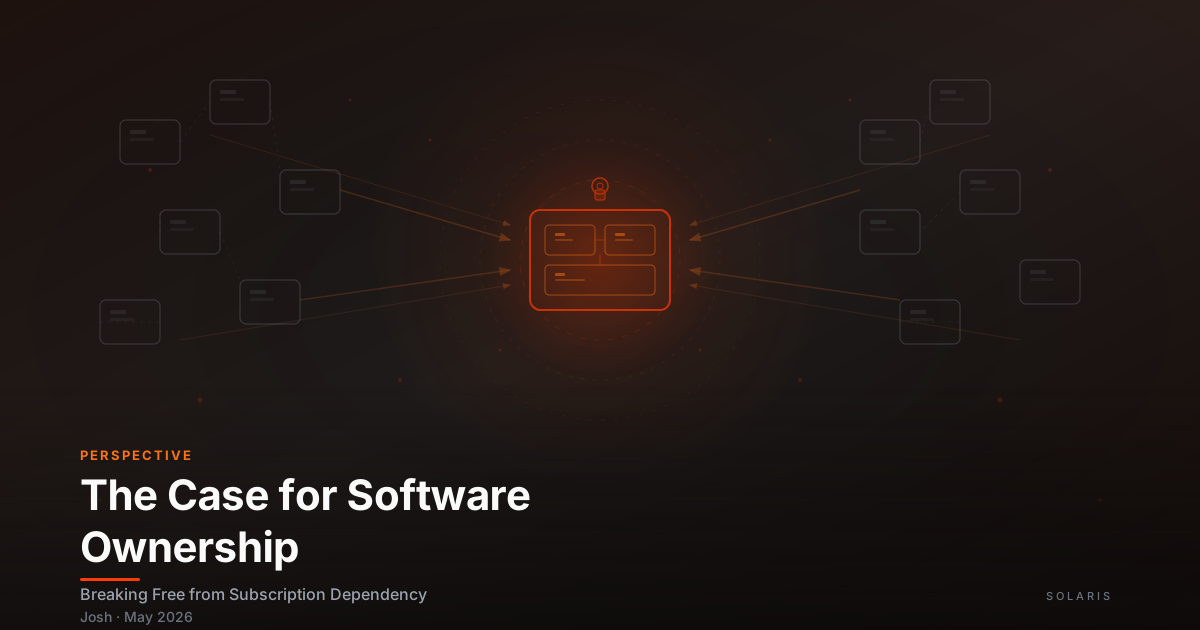
A business should not need ten different providers to manage ten interconnected processes.
It should be able to invest into a single evolving platform tailored to its operations, its staff, and its long-term goals.
Software that adapts.
Software that integrates naturally into the business.
Software that becomes part of the company’s intellectual capital.
Most importantly, software that the business owns.