Artificial intelligence is undergoing a structural shift. For much of its recent history, AI has been framed through the lens of the chatbot: a reactive system in which a user prompts, the model responds, and the interaction terminates until the next query. This paradigm—useful as it has been—represents only an early stage in the evolution of intelligent systems.
What is now emerging is something materially different: AI that does not merely respond, but acts.
From Reaction to Execution
The traditional chatbot model mirrors the earliest phases of computing. Early machines were fundamentally reactive—input produced output, and the system itself remained inert between interactions. Over time, computing evolved into something far more dynamic. We introduced persistent processes, background jobs, event-driven architectures, and scheduled execution through cron systems. Computers began not just to respond, but to operate.
AI is now following the same trajectory.
“Agentic” AI refers to systems that extend beyond passive response into active execution. These systems are capable of performing tasks, invoking tools, orchestrating workflows, and in some cases, maintaining ongoing objectives without continuous human prompting. The distinction is subtle but significant: an agent does not wait to be asked—it is designed to do.
Defining “Agentic” with Precision
The term “agentic” is often used loosely, but it is increasingly acquiring a more precise meaning in practice. At its core, an agentic system is one that can:
- Execute one or more actions in pursuit of a defined objective
- Interface with external tools, APIs, or systems (for example via structured tool protocols or “skills”)
- Maintain context across time, allowing for continuity of work
- Adapt its capabilities dynamically, either through configuration or learning mechanisms
In this sense, an agent is not just a model—it is a system architecture. The model provides reasoning; the surrounding framework provides agency.
Technologies such as tool calling, structured function execution, and emerging protocols for model-context interaction are all converging toward this design pattern. Frameworks like LlamaIndex and LangChain exemplify this shift, enabling developers to build systems where language models operate as decision-making cores within larger, action-oriented pipelines.
The Significance of Openclaw
Recent developments—such as Openclaw—highlight how quickly this paradigm is advancing. While not a final form, Openclaw represents a meaningful departure from static interaction toward autonomous operation.
Its significance lies in three key capabilities:
- Autonomous Task Execution – The system is able to carry out actions without requiring step-by-step prompting
- Capability Expansion – It can acquire or integrate new tools as required by the user’s needs
- Temporal Independence – Through scheduling mechanisms, it can perform tasks over time (e.g., recurring jobs, monitoring, reporting)
This marks a transition from “AI as interface” to “AI as operator”.
Unsurprisingly, major players such as OpenAI, Nvidia, Anthropic, and Moonshot AI are already orienting their roadmaps toward this model. The direction of travel is clear: users are no longer satisfied with answers—they want outcomes.
Why Chat Interfaces Are Not Enough
Chat interfaces remain valuable, particularly for exploration, ideation, and ad hoc problem-solving. However, they are inherently limited:
- They require continuous human initiation
- They lack persistence across time unless explicitly engineered
- They do not inherently execute real-world actions
In contrast, many real-world workflows—particularly in business, law, and operations—are repetitive, structured, and time-sensitive. These are precisely the types of tasks that benefit from automation.
The demand, therefore, is not for better conversation, but for delegation. Users want systems that can be entrusted with responsibility.
The Limits of Generalisation
Despite the ambition surrounding agentic AI, there is a practical constraint that must be acknowledged: no single agent can be universally capable.
From a computational and architectural perspective, attempting to build an all-encompassing agent leads to inefficiency and fragility. The problem scales poorly—what might be framed informally as an “O(n)” expansion of capabilities quickly becomes unmanageable in practice.
A more viable model is one of specialisation.
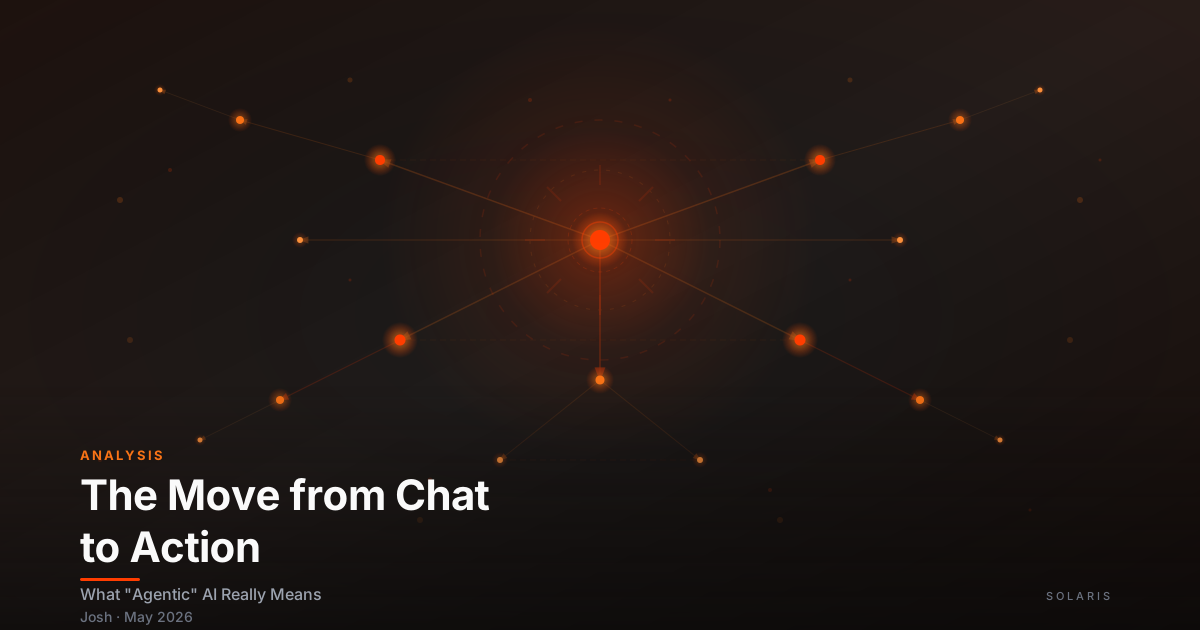
Rather than a monolithic agent, the future is likely to consist of fleets of agents, each designed for a specific domain or function:
- A reporting agent that aggregates and summarises weekly activity
- A compliance agent that monitors obligations and deadlines
- A research agent that retrieves and synthesises domain-specific information
- A communications agent that drafts correspondence or updates stakeholders
These agents can then be orchestrated together, forming a distributed system of intelligence.
Practical Applications: From Theory to Deployment
This is not merely theoretical. Early implementations are already demonstrating tangible value.
In a professional services context, agentic systems can automate workflows such as:
- Generating client reports based on recorded activity
- Extracting key obligations from contracts and surfacing deadlines
- Monitoring regulatory changes and flagging relevant updates
- Coordinating internal processes across teams and systems
By embedding AI into the operational layer—rather than confining it to a conversational interface—organisations can achieve meaningful gains in efficiency, consistency, and scalability.
The Strategic Opportunity
The shift to agentic AI represents more than a technological upgrade; it is a change in how software is conceived.
Where traditional software requires explicit programming for each function, agentic systems introduce a layer of adaptive reasoning that can operate across multiple domains. The role of the developer evolves from writing static logic to designing capability frameworks.
For organisations willing to adopt this model early, the advantages are significant:
- Reduced manual overhead
- Faster execution of routine tasks
- Greater ability to scale without proportional increases in labour
- Enhanced responsiveness to complex, multi-step problems
Conclusion
The movement from chatbot to agent is not a passing trend—it is the next stage in the evolution of intelligent systems. As computing once progressed from passive machines to autonomous processes, AI is now progressing from conversation to action.
The implication is clear: the most valuable AI systems of the near future will not be those that speak most fluently, but those that work most effectively.
The question is no longer what AI can say.
It is what AI can do.